


Manchester City Tactics: Lost Diagonal Weapon
- Dhruv Chopra

- Sep 8, 2025
- 5 min read
Updated: Sep 16, 2025
Manchester City’s identity under Pep Guardiola has long been defined by their dominion of possession. However, after averaging 61.2% of the ball across their opening three Premier League games, the Cityzens are discovering that possession does not precipitate results.
Guardiola’s side has often appeared stagnant and dull with the ball over the past year, a dichotomous contrast to the swift passing sequences and whirlwinds of movement that defined City mere seasons ago. According to Opta, City have the third lowest ‘direct speed’ in the league so far this campaign, a statistic defined as the average speed of vertical ball progression during their passing sequences.
In their recent 2-1 loss to Brighton, this inertia was on palpable display. I believe that it is, at least in part, down to a lethal weapon that City has lost from its tactical repertoire: cross-field diagonal long balls that unlock the threat on their right wing.
Isolation on the Right: Matheus Nunes
A recurring motif in their 2-1 loss to Brighton was that City concentrated buildup play on their left side, as seen in this graphic, where the shade of blue is directly proportional to the concentration of City touches in buildup (via SofaScore, City shooting from right to left):

In a new-look system that Pep deployed against Brighton, fullbacks were instructed to overlap down the flanks to maintain width, while the wingers inverted into the half-spaces to form a narrow front three. This meant that the player who bore the brunt of City’s left side bias was Matheus Nunes.
According to FBref, left back Rayan Aït-Nouri received eight progressive passes in the entire match. In comparison, Nunes received four. Moreover, out of the 17 long balls that goalkeeper James Trafford attempted, only three were directed towards the right wing. As a result, the Portuguese right back was largely isolated and underutilised on the right.
The Tactical Setup: A Missed Opportunity
As a result of the neglection of Nunes on City’s right wing, Brighton did not need to put any effort into neutralising City’s threat on the right. Below is an excerpt from the match:

Oscar Bobb has inverted into the half-space, dragging Brighton LB Maxim De Cuyper inward with him
Brighton LW Kaoru Mitoma cannot track Nunes’ overlapping run because he is marking Bernardo Silva
This leaves Nunes completely isolated on City’s right wing with a vast expanse of space around him
However, City did not make use of this tactical setup, failing to effectually employ their right flank
This is where City’s erstwhile lethal weapon would have come in handy. Long diagonal balls from City’s lower left region to Nunes’ isolated area on the right could have proved the ideal solution.
Aymeric Laporte and the Cross-Field Switch
The long ball in question—a diagonal cross-field switch from LCB to RW—was a City staple during Aymeric Laporte’s spell in sky blue. Pep Guardiola summed it up best when City splurged a then-club record £57m to sign the Spaniard from Athletic Bilbao in January 2018: “He’s the best left central defender in the world.’’
Guardiola’s lyrical about Laporte over the years provides further insight: “He gives us an alternative for the build-up, quicker and faster than the other ones who are right-footed… It helps us to create this build-up, to the left, and to the right with a diagonal pass.”
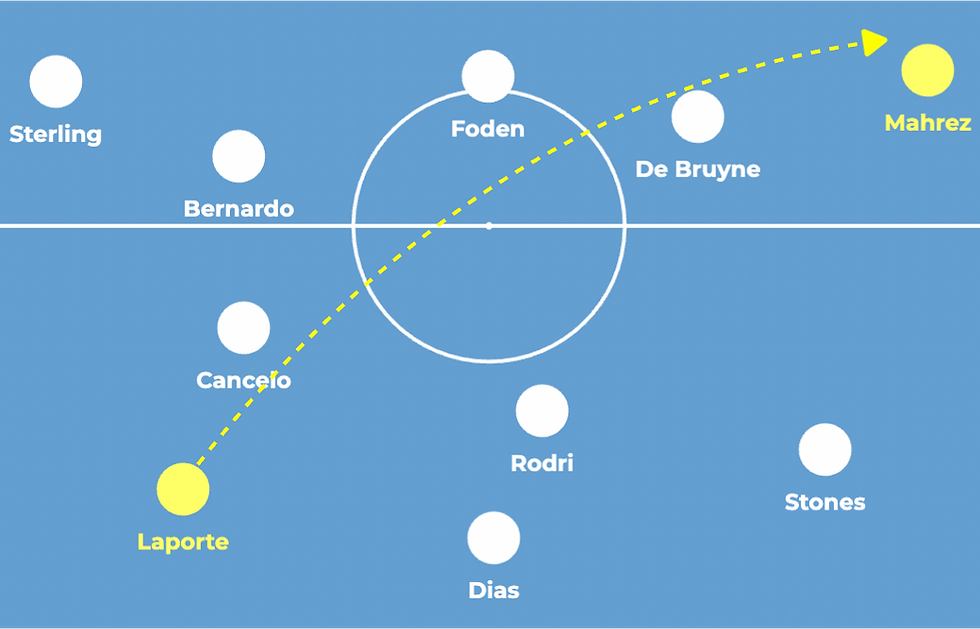
In 2021/22, City’s tactics were centred around Cancelo inverting from LB into DM, while the RB tucked in to form a back three and the RW maintained the width (as seen above in their 2-0 win vs Brentford). Laporte shifted across to LCB, and it was from this role that he was often seen pinging diagonal long balls to Mahrez on the right.
Laporte’s passing accuracy (over 92% in his first four seasons at City), coupled with the Algerian’s sublime first touch, meant that this cross-field switch was a move City could rely on. In fact, Laporte’s progressive ability with the ball resulted in an incredible statistic at Euro 2020: despite being a centre back, the xG value of Laporte’s open play sequence involvement was second only to fellow Spaniard Pedri.
The Lethality of Diagonal Play
What makes such a cross-field long ball so lethal? The answer lies in a simple tactical principle: diagonality.
In football, a vertical pass is the most efficient at gaining ground, but it does not force the opposition to shift their lines horizontally. Additionally, the receiving player is almost always forced to trap the ball with his back towards the opposition goal, limiting his field of view. On the other hand, a horizontal pass is an efficacious way to shift the focal point of the attack and relieve pressure laterally, but it fails to augment a team’s attacking threat.
Nestled within the grey area between these two extremes lies the diagonal ball. With a diagonal pass, vertical threat is amplified without restricting the receiving player’s field of view, and lateral pressure is relieved as well, forcing opposition players to shift their lines in two directions simultaneously across the two-dimensional plane. This nullifies the weaknesses of mere vertical or horizontal long balls while also increasing the probability of a defensive mistake in maintaining a compact structure.
A Potentially Dangerous Tactical Sequence
Particularly in a setup with inverted wingers and overlapping fullbacks, the diagonal cross-field switch is a lethal weapon. Theoretically, a diagonal long ball from Khusanov at LCB to Nunes at RW would have drawn out Brighton LB De Cuyper into the wide area once again, freeing up Oscar Bobb to make a curved run into the channel as shown below and receive a through ball. Bobb could then carry and square the ball to Haaland for a simple tap-in.

The drawback of these long balls is that they are often too lofted and spend a lot of time floating in the air, during which the opposition can reshuffle and reconfigure their marking systems. However, Laporte was proficient at drilling these switches at a comparatively faster pace, which proved to be a lethal weapon to unlock opposition defences.
Dearth of the Diagonal
Manchester City made zero switches in the entire game against Brighton. Centre backs Abdukodir Khusanov and John Stones completed four and two progressive passes respectively, drastically lower figures as compared to Laporte’s average of 9.18 progressive passes per 90 minutes in the 2019/20 season. Khusanov’s progressive pass distance constituted 304 yards, Stones’ was 405 yards, and Laporte’s average at City was 559 yards per game.
In fact, one would have expected these progressive numbers to go up in the time since Laporte’s departure from City. Fewer teams in the EPL are setting up in low blocks and considerably more teams are pressing aggressively on the front foot, and these tactical trends have precipitated an increase in transitional play from five years ago, creating the perfect tactical climate for these diagonal switches to become more effectual. City’s numbers have, on the contrary, only come crashing down.
What Does the Future Hold?
The loss of this cross-field ball from their attacking arsenal could, perhaps, be attributed to City’s lack of a left-footed centre back. Joško Gvardiol’s injury means that right-footed players like Khusanov, Stones, or Dias are deployed at LCB, and a right-footed long ball from that area to the right flank is more likely to be blocked by pressing opposition players. The Croatian’s return could result in the satisfactory utilisation of City’s right flank to maintain pace on the ball and fabricate attacking chances.
At the moment, however, City’s right wing remains underemployed, resulting in opposition teams having a numerical advantage in other areas. This is a strategic problem that Pep Guardiola needs to sort out to prevent his side from appearing stagnant in possession. The cross-field long diagonal switch is a lethal weapon that Manchester City has lost from its tactical repertoire. Rediscovering it could be the key to unlocking their attack again.
Click here to check out Dhruv's Corner for more articles covering tactical, statistical, economic and political aspects of world football!
