


Pep Guardiola Tactical Adaptability: How Manchester City’s Evolution Sparked a Revival
- Dhruv Chopra

- Sep 22, 2025
- 5 min read
Improvise, adapt, overcome. This has been Pep Guardiola’s solution to Manchester City’s prolonged stagnation, and after a decade of the Spaniard adhering to his tactical ideals at City, it is a surprising one.
Recognising that his archetypal footballing style—characterised by dominance of possession, passing triangles and patient build-up play—was no longer able to maximise the strengths of City’s personnel, Pep chose to compromise on his tactical ideals for the recent games against Manchester United and Arsenal.
The Cityzens endured a challenging run of fixtures, coming through with a 3-0 derby win followed by a 2-0 victory against Napoli in midweek and a 1-1 draw away at Arsenal. Here are three tactical adaptations that Pep has made to his side recently and how they have led to City’s turnaround in form.
01: Possession and In-Game Management
“What I want, my desire, is to have 100% possession,” were the words that Pep Guardiola used following Bayern Munich’s 5-1 demolition of Arsenal in the Champions League in 2015. It is a sentiment that has defined Pep’s coaching career: hegemony over the ball.
In the second half of the Manchester derby, however, Pep’s side were content with their opponents controlling the ball, and City had merely 30% of possession. Moreover, in their 1-1 draw to Arsenal, City had only 33% of the ball in the entire game, with a mere 23% in the opening 15 minutes.
In fact, Guardiola replaced right winger Bernardo Silva with centre back Nathan Aké in the 88th minute of the derby in an attempt to see off their 3-0 lead and keep a clean sheet. Aké was seen holding up the fingers ‘five, four, one’ to his teammates. Pep’s instructions were to set up the side in the ultimate low block formation:
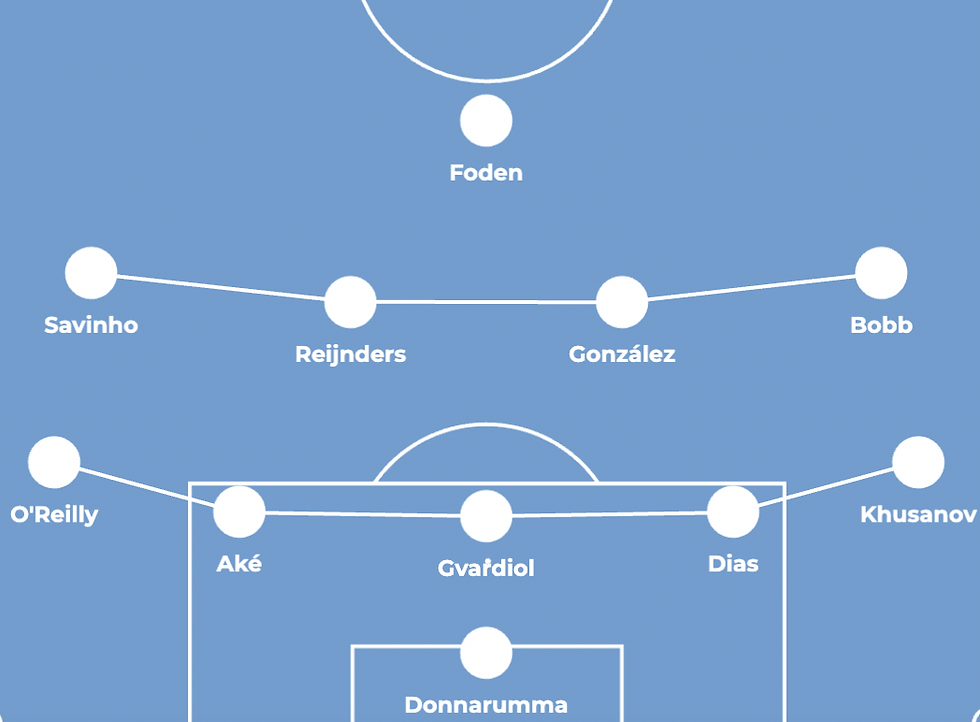
While this infuriated multifarious proponents of front-foot, attacking football, the truth was that it saw out the win against United with a clean sheet, epitomising adaptability on the basis of present game state. This was also visible in the second half of their 1-1 draw against Arsenal, where City maintained a compact structure that came minutes away from seeing through a win at the Emirates.
02: Decreased Pressing Intensity
United’s second half dominance against City last weekend, as well as Arsenal’s control over their latest game, was partly enabled by Pep’s instruction to his forward line to let the opposition centre backs have the ball. The likes of Haaland and Foden, expected to lead City’s press in their regular 4-4-2 off-ball shape, held their positions and marked defensive midfielders to prevent the progression of the ball.
Simultaneously, City’s fullbacks, who were expected to aggressively advance to mark United’s wingbacks and Arsenal’s fullbacks, instead maintained the backline while City’s wingers blocked passing lanes into these wide players. By maintaining a compact and well-drilled structure off the ball, Guardiola forced United and Arsenal to play long balls to their attackers.
With the low probability that long balls possess, United failed to efficaciously progress the ball, instead passing it around in their own third of the pitch. If Pep had chosen to continue with his regular pressing structure, United’s buildup could have borne fruit by exploiting the space behind City’s jumping fullbacks via wide overloads. Amorim had no answer to Pep’s simple yet unexpected compromise, a key factor in City’s 3-0 triumph over their rivals.
In the match against Arsenal, it was a pinpoint long ball from Eze that clinched a point for the Gunners, with City’s defence caught out by a blistering run from substitute Gabriel Martinelli. However, this off-ball strategy manifested a dramatic turnaround for Pep Guardiola, limiting a rhythmic and in-form Arsenal side to one goal.

03: Transitional Play and Long Balls
In the aftermath of an era defined by Ederson’s impeccable distribution and aptitude in buildup and with the arrival of Gianluigi Donnarumma, it was evident to the fans that Pep’s patient passing strategy would not immediately click with his available squad.
Cue Pep’s third tactical compromise: embracing the transitional game. Even when City attempted a slow buildup in the matches against United and Napoli, it was only to bait the opposition press before playing an aerial pass into the vacated spaces behind these pressing players. City played a remarkable 55 long balls against United last weekend, comprising almost 13% of their total passes.
This suited the skillet of Donnarumma, who is less comfortable with distribution under pressure, as well as that of Erling Haaland, who is at his most formidable when unleashed in a role running at opposition centre backs into the channels with pace. City’s strategy from goal kicks was often a route one ball straight to Haaland, who held the defender off with commendable holdup play before playing it off to a teammate and making a run into the space behind the defence.
In fact, it was this exact strategy that resulted in Giovanni Di Lorenzo’s early red card for Napoli in the Champions League, the tipping point in an otherwise well-poised matchup. Donnarumma’s long ball was directed towards Haaland. Despite the Norwegian losing the header to Napoli centre back Sam Beukema, the second ball fell to Foden. With City’s transitional setup, it could have fallen to any of the four attackers behind Haaland, all of whom had narrowed their positioning to attack this second ball.

Since Beukema was now out of the equation with his advanced positioning, Haaland made a run into the space in behind, and Foden found him with a sublime through ball that forced Di Lorenzo to make a last man foul. City’s newfound directness was what cost Napoli the game.

City’s only goal against Arsenal stemmed from a similar setup. Haaland dropped down and played a through ball to Tijjani Reijnders in an attempt to turn the tide of momentum. In the process, the Norwegian had drawn out Arsenal centre back Gabriel and vacated space in behind the Arsenal backline, which he burst into, eventually scoring a well-taken and direct goal. City’s transitional game has helped Haaland return to his unmistakable, intimidating best.
Conclusion
Never adapt the players to suit the system. Adapt the system to suit the players. Pep Guardiola has taken this managerial gospel to heart in the past few matches, and without his tactical compromises, City’s recent fixtures would have proven to be considerably tougher tests.
It is refreshing to see that Pep Guardiola is willing to maximise his player’s strengths and adapt to the modern game rather than stubbornly adhere to his tactical ideals. City now come away with two wins and a draw from three demanding fixtures. Critics of the defensive game are as outspoken as ever, but for City fans, the future is bright.
Click here to check out Dhruv's Corner for more articles covering tactical, statistical, economic and political aspects of world football!


